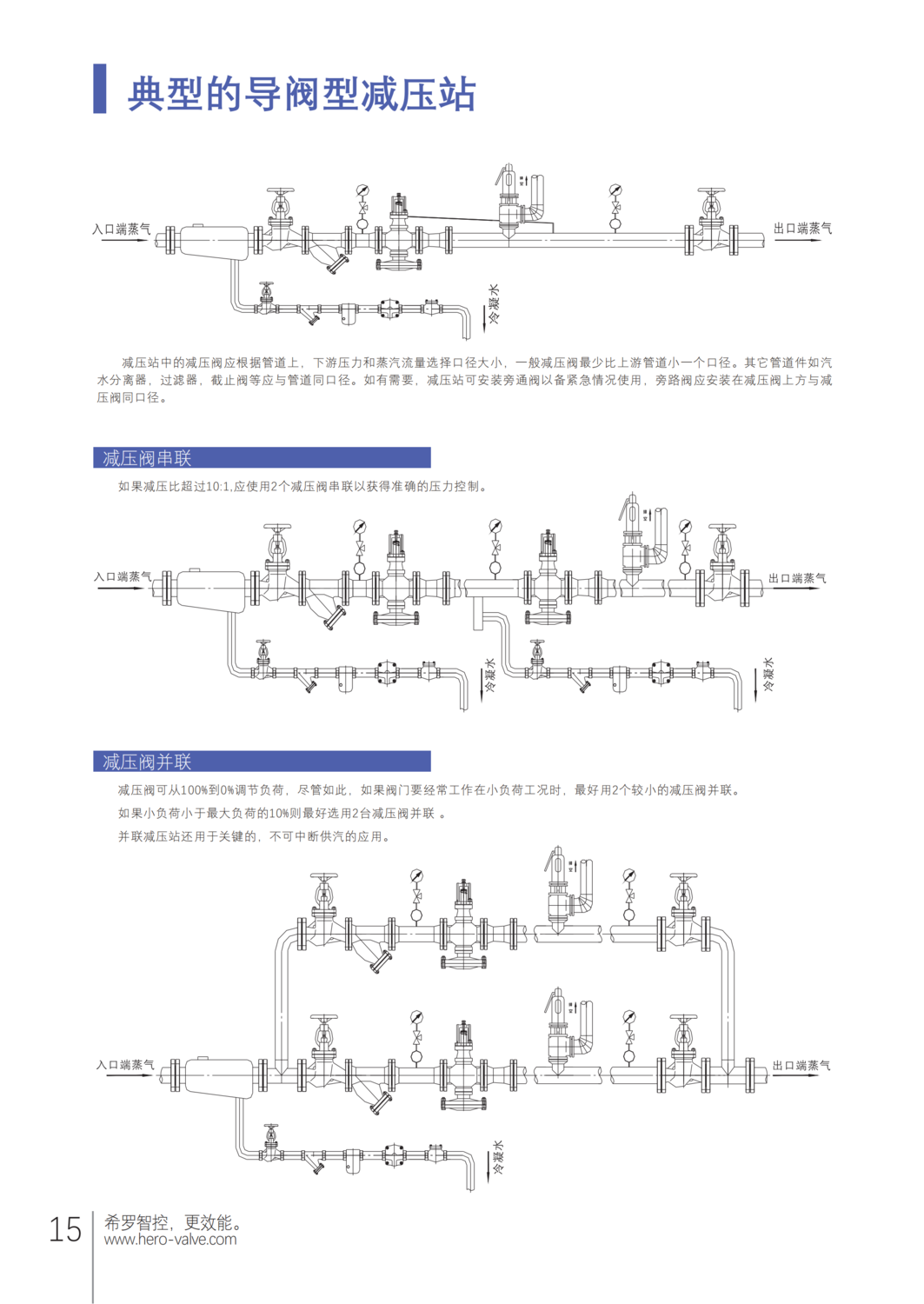
The Y43H steam pressure - reducing valve is a commonly used type of pressure - reducing valve:
Structural Features
Piston - type Structure: The Y43H steam pressure - reducing valve adopts a piston - type structure. The opening of the valve is adjusted through the up - and - down movement of the piston, thereby controlling the pressure of the steam. This structure has the advantages of sensitive action and high adjustment accuracy. It can quickly respond to changes in system pressure and stably control the outlet pressure within the set range.
Spring - diaphragm Structure: Some Y43H steam pressure - reducing valves also adopt a spring - diaphragm structure, using a combination of a spring and a diaphragm to achieve pressure adjustment. The advantages of this structure are its compactness and good sealing performance. It can effectively prevent steam leakage and also has good stability and reliability.
Working Principle
When steam enters the pressure - reducing valve from the inlet end, it flows towards the outlet end through the gap between the valve seat and the valve core. During this process, the pressure of the steam acts on the valve core, generating an upward force on it.
When the steam pressure at the outlet end exceeds the set value, the valve core moves upward under the action of the steam pressure, reducing the gap between the valve seat and the valve core. This reduces the steam flow rate and decreases the outlet pressure.
Conversely, when the steam pressure at the outlet end is lower than the set value, the valve core moves downward under the action of the spring force or the diaphragm force, increasing the gap between the valve seat and the valve core. This increases the steam flow rate and raises the outlet pressure. In this way, the Y43H steam pressure - reducing valve can automatically adjust the steam pressure to keep it within the set range.
Performance Parameters
Nominal Pressure: The Y43H steam pressure - reducing valve generally has a variety of nominal pressure specifications for selection. Common ones include 1.0MPa, 1.6MPa, 2.5MPa, etc., to meet the pressure requirements of different steam systems.
Nominal Diameter: Its nominal diameter range is relatively wide, ranging from DN15 to DN200. An appropriate diameter size can be selected according to the actual steam flow requirements.
Pressure Adjustment Range: The pressure adjustment range of this pressure - reducing valve is usually from 0.05MPa to 1.0MPa, which can meet the pressure - reducing needs of most steam users. The pressure adjustment ranges of different specifications and models of pressure - reducing valves may vary slightly.
Material Selection
Valve Body Material: The valve body is usually made of cast steel or stainless steel. Cast steel has good strength and toughness and can withstand high pressures and temperatures, making it suitable for general industrial steam systems. Stainless steel has excellent corrosion resistance and is suitable for steam systems with high hygiene requirements or where the medium is corrosive.
Sealing Material: Sealing components generally use materials such as rubber or polytetrafluoroethylene. Rubber seals have good elasticity and sealing performance, but their temperature - resistant performance is limited. Polytetrafluoroethylene seals have excellent corrosion resistance and high - temperature resistance and can maintain good sealing performance within a wide temperature range.
Installation and Maintenance
Installation Requirements: The Y43H steam pressure - reducing valve should be installed on a horizontal pipeline, and a filter should be installed before the valve to prevent impurities from entering the pressure - reducing valve and affecting its normal operation. During installation, pay attention to making the steam flow direction consistent with the arrow direction on the valve body. Reverse installation is not allowed. At the same time, ensure that the pressure - reducing valve is firmly installed to avoid vibration and displacement during operation.
Maintenance Points: Regular maintenance of the pressure - reducing valve is the key to ensuring its stable performance. Maintenance content includes checking the sealing performance, cleaning impurities, and checking the elasticity of the spring and diaphragm. If the sealing parts are found to be aged or damaged, they should be replaced in a timely manner. If the spring or diaphragm has insufficient elasticity, adjustments or replacements should be made. In addition, the pressure - reducing valve should be calibrated regularly to ensure that its pressure adjustment accuracy meets the requirements.
Application Fields
Industrial Steam Systems: In various industrial production processes, such as the paper - making, textile, printing and dyeing, chemical, and pharmaceutical industries, the Y43H steam pressure - reducing valve is widely used in steam pipeline systems to reduce high - pressure steam to the required low - pressure steam to meet the steam pressure requirements of the production process.
Heating Systems: In central heating systems, this pressure - reducing valve can be used to reduce the high - pressure steam in the heating pipeline network and supply it to users, ensuring stable steam pressure at the user end and improving the heating quality.
Food Processing Industry: During food processing, high requirements are placed on the pressure and hygiene of steam. The Y43H steam pressure - reducing valve is made of stainless steel, which can meet the hygiene standards of the food industry and provide stable and clean low - pressure steam for food processing.