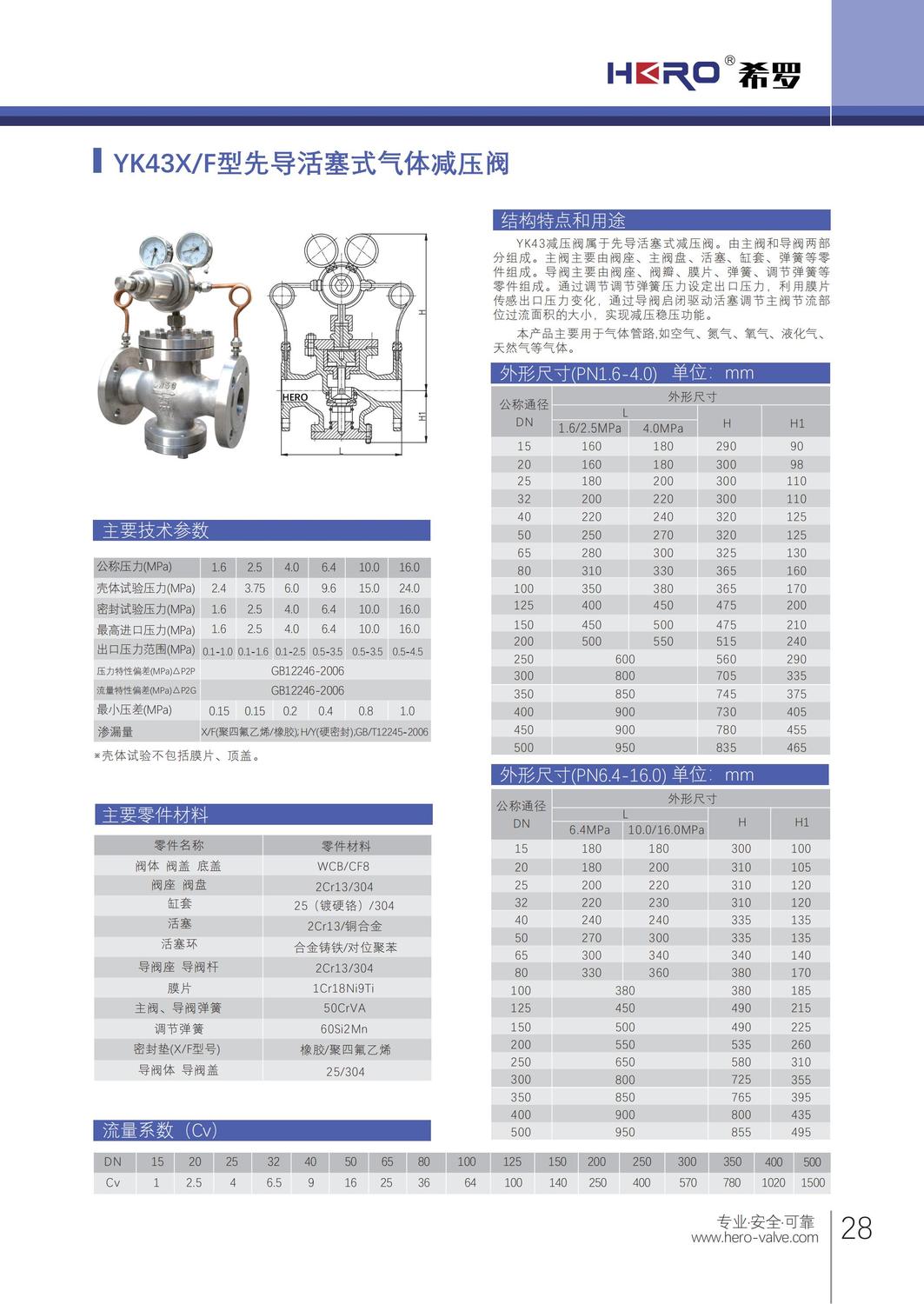
The YK43X pressure - reducing valve is a pilot - piston type gas pressure - reducing valve.
Structural Composition:
Main Valve Part: It mainly consists of components such as the valve seat, main valve disc, piston, cylinder sleeve, and spring. These parts work in coordination and play a crucial role in the pressure - reducing process. For example, the piston moves within the cylinder sleeve according to pressure changes, thereby regulating the gas flow rate and pressure.
Pilot Valve Part: It mainly includes parts such as the valve seat, valve flap, diaphragm, spring, and adjusting spring. The diaphragm can sense changes in the outlet pressure. The opening and closing of the pilot valve drive the piston, and then adjust the flow - through area of the throttling part of the main valve, achieving the functions of pressure reduction and pressure stabilization.
Working Principle: The outlet pressure is set by adjusting the pressure of the adjusting spring. When gas enters the pressure - reducing valve from the inlet, it first passes through the pilot valve. The pilot valve controls the movement of the piston based on the changes in the outlet pressure sensed by the diaphragm. The movement of the piston changes the flow - through area of the throttling part of the main valve, thus keeping the outlet pressure within the set range.
Applicable Media: It is mainly used in gas pipelines for various gases such as air, nitrogen, oxygen, hydrogen, liquefied gas, and natural gas.
Technical Parameters:
The nominal pressure is available in various specifications, such as 1.6MPa, 2.5MPa, 4.0MPa, 6.4MPa, 10.0MPa, 16.0MPa, etc.
The outlet pressure range varies according to different nominal pressures. For example, under some pressure levels, the outlet pressure range is 0.1 - 1.0MPa, 0.1 - 1.6MPa, 0.1 - 2.5MPa, etc.
It has certain requirements for pressure characteristic deviation and flow characteristic deviation, and must comply with relevant standards (such as GB12246 - 1989).
The normal operating temperature of the YK43X pressure - reducing valve is generally 0℃ - 80℃. However, in some cases, due to special specifications or application scenarios, its operating temperature can reach ≤150℃.
Installation and Usage Precautions:
Before installation, carefully check whether the usage conditions match the specifications on the nameplate. The valve should be installed on a horizontal pipeline, and the arrow shown on the valve body should be in the same direction as the medium flow.
There should be a straight pipe section before and after the pressure - reducing valve. The length of the straight pipe section before the valve should be more than 0.6xDN, and after the valve should be more than 10xDN (DN is the nominal diameter).
When installing, remove the end caps of the valve, check whether the connecting bolts are loose, and ensure that the pipeline before the valve is flushed clean. During use, the medium must be filtered through a filter.
During use, slowly rotate the adjusting screw clockwise to increase the outlet pressure to the required value. After adjustment, lock the screw.