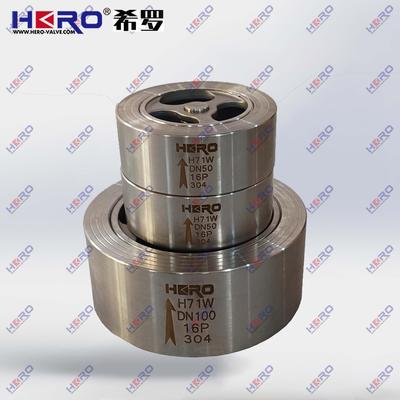
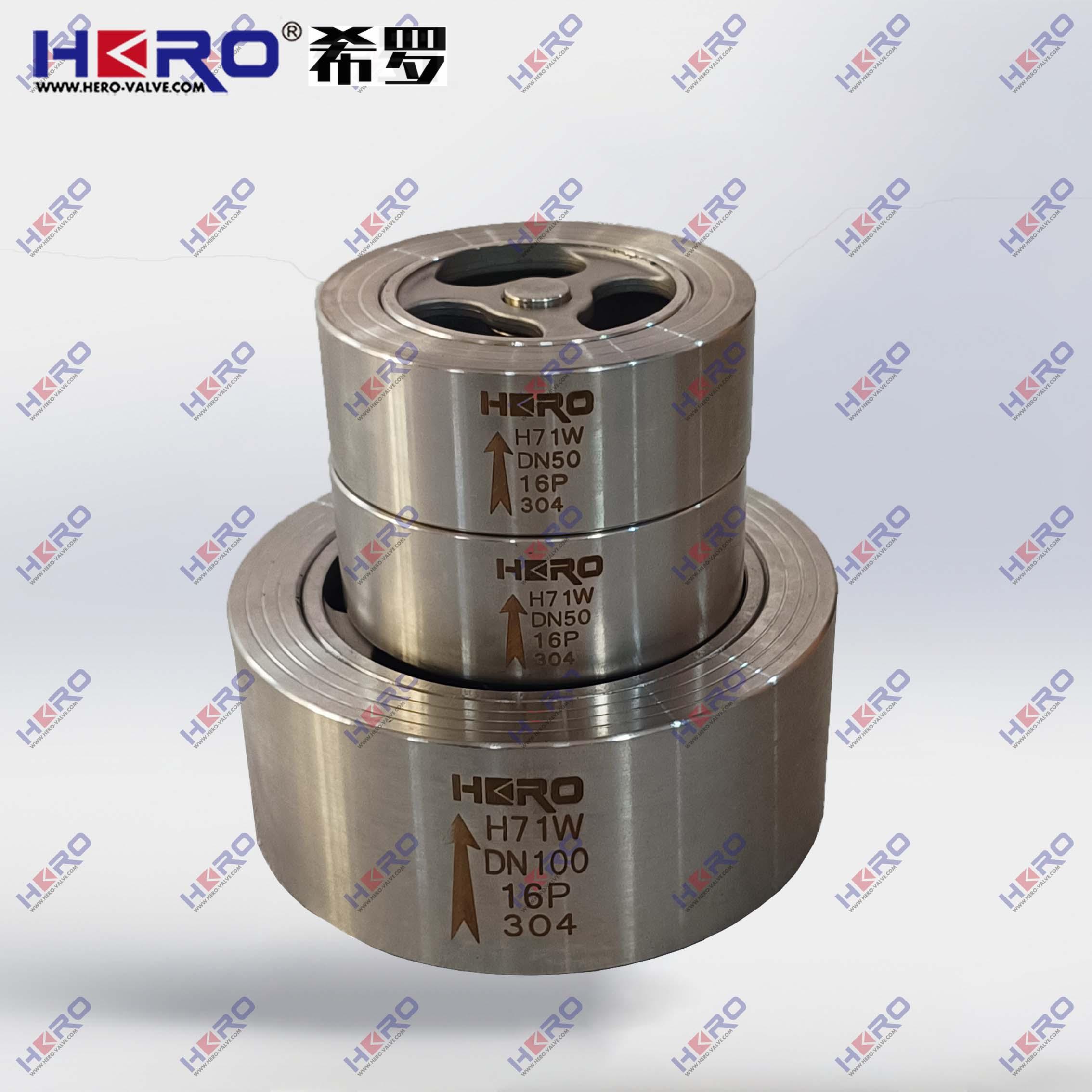
Wafer check valve is mainly composed of valve body, butterfly double valve disc, valve stem and spring.
Scope of application
Wafer check valves are widely used in pharmaceutical, food, chemical, metallurgy, electronics and other industries, and can be applied to various media such as water, steam, oil, nitric acid, acetic acid, strong oxidizing media and uric acid.
working principle
The wafer check valve only allows the medium to flow in the same direction, thereby generating pressure to open the valve disc. When the fluid flows in the opposite direction, the fluid pressure and the self-weight of the valve disc act on the valve seat, thereby cutting off the flow.
Structural features
1. The structural length is short, and its structural length is only 1/4~1/8 of the traditional flange check valve;
2. Small size and light weight, its weight is only 1/4~1/20 of the traditional flange check valve;
3. The valve disc closes quickly and the water hammer pressure is small. 4. It can be used in horizontal or vertical pipelines and is easy to install. 5. The flow channel is smooth and the fluid resistance is small. 6. It has sensitive action and good sealing performance;
7. The valve disc has a short stroke and small closing impact;
8. The overall structure is simple and compact, and the shape is beautiful;
9. Long service life and reliable performance.
Features
1. The water hammer pressure is small, the valve disc is short in opening and closing, the valve disc is delicate, and has spring-assisted closing;
2. When the valve is closed, the impact force is small, the water hammer pressure is small, and the reliability is high;
3. The structure is short in length, small in size and light in weight. The valve is simple and compact;
4. The fluid resistance is large, with a coefficient of 6.4-2.8;
5. The opening pressure is small, and the valve disc can be fully opened under a small pressure difference;
6. Can be installed horizontally and vertically, easy to install.
Installation Precautions
1. When placing the pipeline, attention should be paid to making the passage direction of the wafer check valve consistent with the flow direction of the fluid;
2. Installed in vertically placed pipelines. For horizontally placed pipelines, place the wafer check valve vertically;
3. Use a telescopic tube between the wafer check valve and the butterfly valve, and never connect it directly to other valves;
4. Avoid adding pipe joints and obstructions within the operating radius of the valve plate;
5. Do not install a reducing pipe in front or behind the wafer check valve;
6. When installing a wafer check valve near an elbow, be sure to leave enough space;
7. When installing a wafer check valve at the outlet of the water pump, at least a space six times the diameter of the valve must flow out to ensure that the butterfly plate is eventually affected by the fluid.