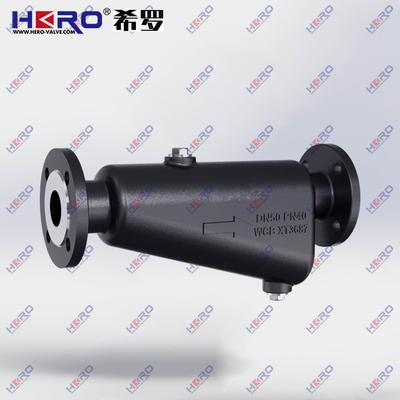
The CF series steam-water separators are devices used to separate suspended water droplets in steam or compressed air :
Working Principle
Baffle-type Separation: Baffles are used to make the fluid change its flow direction multiple times inside the separator. The suspended water droplets, due to their relatively large mass and inertia, cannot bypass the baffles like dry steam when they encounter the baffles. Instead, they accumulate on the baffles and finally fall to the bottom of the separator.
Centrifugal Separation: By making the steam or compressed air rotate at a high speed, under the action of centrifugal force, the water droplets with a higher density are thrown towards the wall surface of the separator, and then flow down along the wall surface to achieve the separation of steam and water.
Product Features
High Separation Efficiency: For example, the dryness of the CF11 steam-water separator can reach 98%, and the CF41 can provide high-dryness steam for steam equipment, effectively improving the thermal efficiency of the equipment.
Low Pressure Drop: For instance, the pressure drop of the CF11 steam-water separator is approximately five thousandths, which has a small impact on the system pressure and reduces energy loss.
Automatic Adjustment: The CF41 type can automatically adjust the steam intake according to the changes in steam pressure and water pressure, overcoming defects such as vibration and noise.
Good Energy-saving Effect: The CF41 can achieve pressure increase while using steam for heating, greatly reducing the power of the water pump motor. Compared with the traditional heat exchange system, it can save more than 20% of steam.
Wide Application Range: It is suitable for the heating and hot water supply systems of residential buildings, commercial office buildings, hotels, hospitals, and bathing centers, as well as industries such as power, chemical, rubber, food, papermaking, and pharmaceuticals.
Technical Parameters
Nominal Diameter: The nominal diameter of the CF41 is generally DN15-DN150mm, and that of the CF11 is usually also DN15-DN150mm.
Nominal Pressure: Common ones are PN1.6-PN2.5Mpa.
Operating Temperature: Generally between 220-350°C.
Materials and Connection Methods
Materials: The valve body materials mainly include cast iron, cast steel, stainless steel, etc. For example, the valve body of the CF41 is commonly made of cast iron, and the CF11 is usually made of cast steel. The filter cover is generally made of stainless steel material to ensure corrosion resistance and separation effect.
Connection Methods: They include threaded connection, flange connection, etc. Small-diameter CF11 and CF41 steam-water separators mostly use threaded connections, while large-diameter ones usually adopt flange connections, which are convenient for installation and disassembly.
Installation Precautions
Pipeline Cleaning: Before installation, the pipeline must be purged with pressurized gas to remove dirt and debris to prevent the separator and the steam trap from being blocked.
Installation Position: It should be installed at a lower position of the steam pipeline to facilitate the discharge of condensed water. It is recommended to install stop valves before and after the separator for easy maintenance and replacement.
Installation Direction: The arrow on the valve body should point in the same direction as the fluid flow direction in the pipeline to ensure the correct operation of the steam-water separator.
Installation of Steam Trap: A steam trap should be installed at the lower part of the steam-water separator. The steam trap should be selected with an appropriate model according to the displacement and working conditions to ensure that the separated condensed water can be discharged in a timely manner.
Installation of Filter: To prevent the steam-water separator and the lower steam trap from malfunctioning due to dirt blockage, it is recommended to install a Y-type filter in front of the steam trap and carry out regular cleaning work.