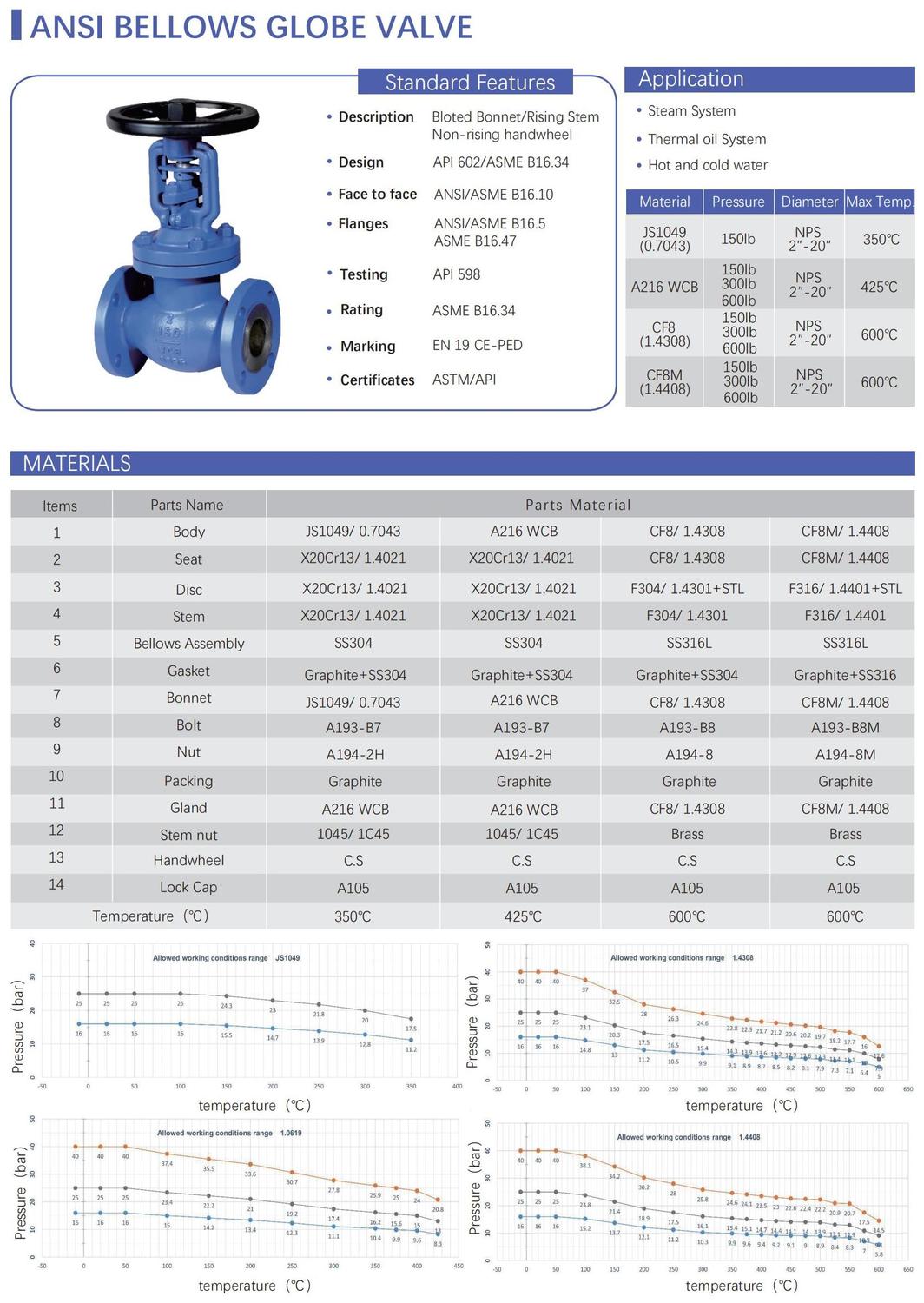
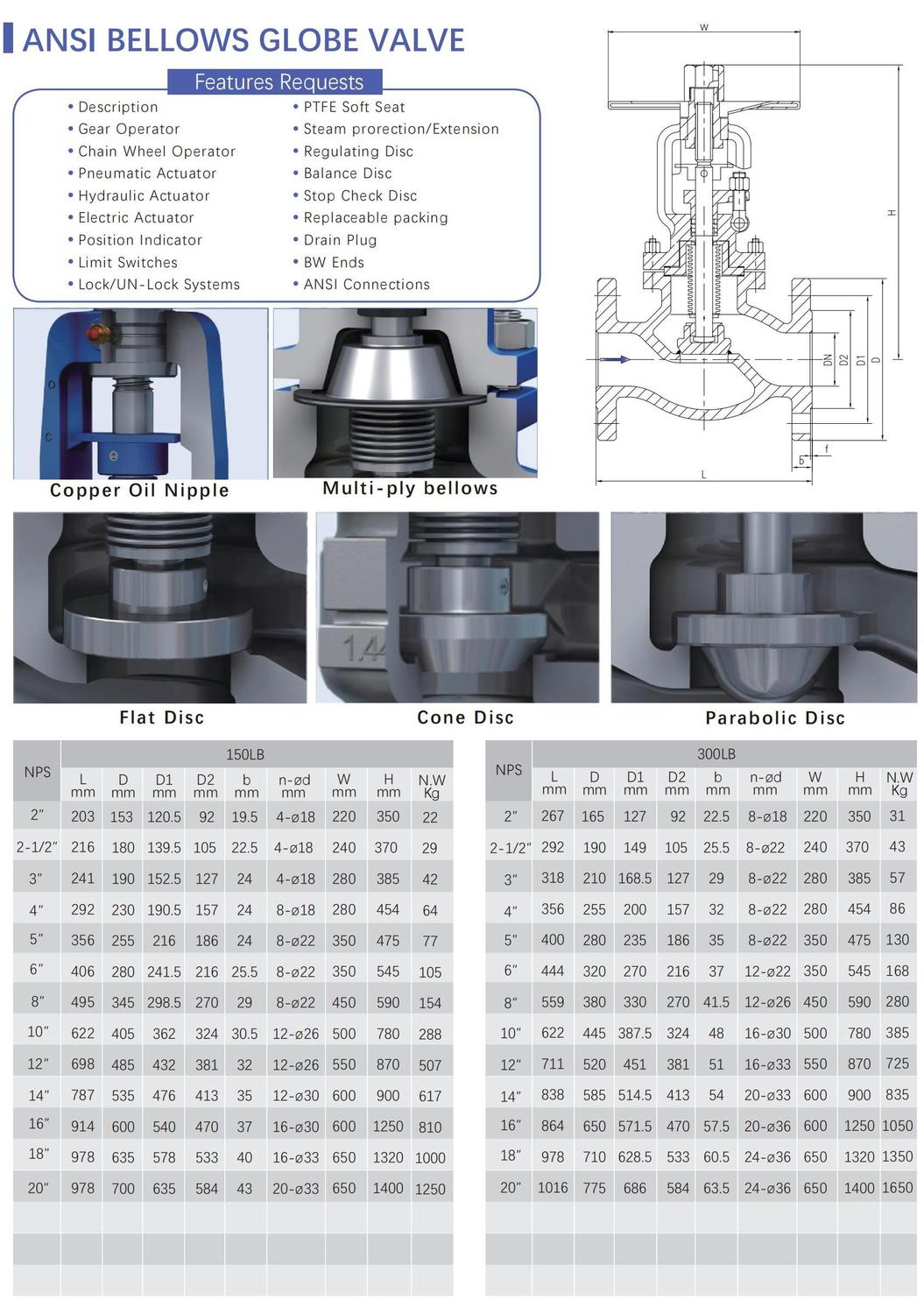
The bellows globe valve is a crucial type of industrial valve. Here is a brief introduction:
Definition and Working Principle
Definition: A bellows globe valve is a valve that uses a bellows as a sealing element and controls the passage of the medium by tightly fitting the valve disc to the valve seat.
Principle: By rotating the valve stem, the valve disc moves up and down along the axis of the valve stem. When the valve disc descends and comes into close contact with the valve seat, the valve closes to prevent the medium from flowing. When the valve disc rises and leaves the valve seat, the valve opens to allow the medium to pass through. During the movement of the valve stem, the bellows expands and contracts accordingly, preventing the medium from leaking along the valve stem and achieving reliable sealing.
Structural Features
Bellows Sealing Structure: The bellows serves as the main sealing component, completely isolating the valve stem from the medium. This effectively prevents external leakage of the medium, ensuring excellent sealing performance. It is especially suitable for pipelines transporting toxic, harmful, flammable, explosive, and valuable media.
Dual - Sealing Design: Generally, in addition to the bellows sealing, a packing seal is also provided as an auxiliary seal. In case of an abnormal situation with the bellows, the packing seal can act as a backup seal, further enhancing the sealing reliability of the valve.
Valve Disc and Valve Seat: The sealing surfaces of the valve disc and valve seat usually undergo special treatment, such as hard - alloy surfacing or the use of wear - resistant and corrosion - resistant materials. They possess good wear - resistance, corrosion - resistance, and anti - scuffing properties, ensuring long - term and stable sealing performance.
Valve Stem and Actuating Device: The valve stem is typically made of high - strength and corrosion - resistant materials. Its surface is precisely processed and treated, endowing it with good wear - resistance and corrosion - resistance. There are various actuation methods available. You can choose manual, electric, pneumatic, or other types of actuating devices according to actual needs, which facilitate operation and control.
Performance Advantages
Excellent Sealing Performance: The sealing function of the bellows results in minimal internal and external leakage of the valve. It can meet the high - sealing requirements of working conditions, effectively preventing safety accidents and environmental pollution caused by medium leakage.
Strong Corrosion Resistance: Key components such as the bellows, valve disc, and valve seat are made of corrosion - resistant materials. This enables the valve to operate stably in various corrosive media, extending its service life and reducing maintenance costs.
Precise Throttling Control: By accurately controlling the opening of the valve disc, precise regulation of the medium flow rate can be achieved. It is suitable for applications where precise flow control is required, such as metering control in chemical production and flow regulation in fluid transportation.
Wide Range of Applications: It can be applied to a variety of media, including water, steam, oil products, various corrosive chemical media, etc. Moreover, it can operate within a wide temperature and pressure range. Generally, the pressure range can reach PN1.0 - 42.0MPa, and the temperature range is approximately - 29°C - 550°C, depending on the material selection.
Application Fields
Petrochemical Industry: In the processes of petroleum refining and chemical production, it is used in pipelines for transporting various petroleum products and chemical raw materials, such as crude oil transportation, inlets and outlets of chemical material reaction kettles, and material transportation in distillation towers. It ensures the safety and stability of the production process.
Power Industry: In power facilities such as thermal power plants and nuclear power plants, it is commonly used in pipeline systems for steam, water, oil, and other media, such as main steam pipelines, feed - water pipelines, and cooling water pipelines. It plays an important role in ensuring the normal operation of the power system.
Pharmaceutical Industry: In the pharmaceutical process, it is used in pipelines for transporting various drug raw materials, intermediates, and finished products. It meets the strict requirements for medium purity and tightness in the pharmaceutical process, preventing drug contamination and leakage, and ensuring the quality and safety of drugs.
Other Fields: It is also widely used in industries such as natural gas transportation, metallurgy, papermaking, printing and dyeing, and food and beverage. It is used to control the flow of various fluid media, achieving precise control and safe operation of the technological process.